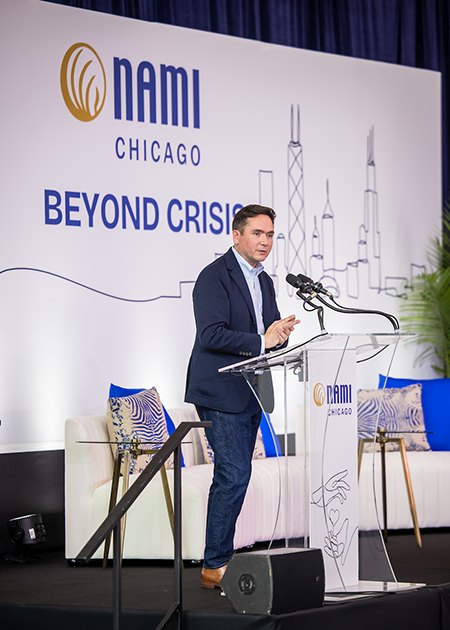
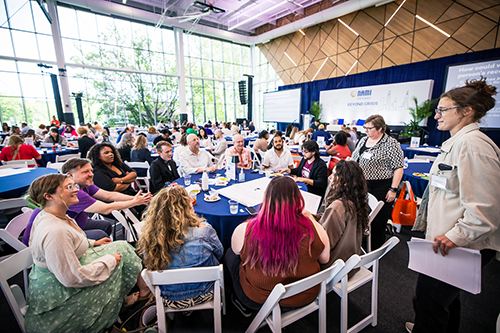
Moving beyond crisis
The Beyond Crisis Coalition
The Beyond Crisis Coalition brings together people with lived experience, providers, policymakers, funders, advocates, and cross-sector partners across Chicago to build a coordinated, community-based prevention and post-crisis ecosystem for people living with serious behavioral health conditions.
This work will begin with the Beyond Crisis Summit in the summer 2026 and continue through ongoing coalition efforts. This is not a one-time event. It is the start of a longer-term effort to align partners around shared goals, clear roles, and concrete actions.
If you are interested in participating in the Beyond Crisis Coalition, contact our policy team to learn more.
The Beyond Crisis Summit is Sold Out.
Event Details
Date: Thursday, July 9th
Time: 9:00 am – 4:30 pm
Location: Obama Center Home Court (6121 S Stony Island Ave, Chicago, IL 60637)
Parking/Transportation
We encourage carpooling, ridesharing, or taking public transit to the Obama Presidential Center. While a parking garage is available on-site, it is open to all Center visitors and may fill up quickly. If you plan to drive, we recommend arriving early. Limited street parking is also available in the surrounding area.
*Please note registration for Beyond the Crisis Summit is now full.
Run of Show
9:00 – 9:45 am: Registration, Breakfast and Networking
9:45 – 10:00 am: Welcome and Event Overview
10:00 – 10:20 am: Keynote Speaker: Tom Insel, MD
10:20 – 10:30 am: Transition Time
10:30 – 11:30 am: Lived Experience Panel
11:30 am – 12:15 pm: Lunch
12:15 – 12:30 pm: Afternoon Walkthrough
12:30 – 1:30 pm: Breakout Session Block 1
1:30 – 1:45 pm: Transition Time
1:45 – 2:45 pm: Breakout Session Block 2
2:45 – 3:00 pm: Transition Time
3:00 – 4:15 pm: Tabletop Exercise
4:15 pm: Closing
Presentations & Panel Details
Presentation: The Clubhouse Model with Fountain House
Presentation Overview: A clubhouse is a community-based location designed to support the recovery of people living with serious mental illness (SMI). Each clubhouse provides a restorative environment for people whose lives have been severely disrupted because of their mental illness. It all starts with the idea that “community is therapy.” Attend this session to learn about clubhouses from the organization that started it all, Fountain House.
Presenters: Ken Zimmerman, Chief Executive Officer, Joshua Seidman, Chief External Impact Officer, Faith Emmanuelle, Advocate
Location: Second Floor Breakout Room 1
Panel: Building Forward with Rush Street Psychiatry and Northwestern’s Lab for Scalable Mental Health
Panel Overview: This breakout session will explore innovative, prevention-focused approaches to engaging individuals before a mental health crisis occurs or during the early stages of need. Panelists will share how their programs are pushing the envelope in outreach, relationship-building, and service design to better connect with individuals and communities.
Panelists: Samuel Jackson, M.D., Street Psychiatrist and Dr. Jessica L. Schleider, Founding Director of the Lab for Scalable Mental Health and Associate Professor at Northwestern University.
Location: Lower Level Breakout Room
Panel: Early Intervention, First Episode Psychosis with Northwestern Medicine and Yale University STEP Learning Collaborative
Panel Overview: This panel will discuss the critical importance of early intervention for individuals experiencing psychosis and how timely, coordinated care can improve recovery outcomes, quality of life, and life expectancy. Panelists will discuss innovative models that connect individuals to specialized care within the first three years of diagnosis, pairing clinical treatment with wraparound social services to help reduce recurring episodes and break cycles of crisis.
Panelists: Jenny Zhang, MD, PhD, Psychiatrist at Northwestern Memorial Hospital and Co-Director of Northwestern Medicine’s Recovery from Early Psychosis Program, and Sumeyra Tayfur, PhD, Clinical Psychologist and Postdoctoral Associate in the Department of Psychiatry at Yale School of Medicine and Early Detection and Assessment Coordinator for the STEP Learning Collaborative
Location: Second Floor, Breakout Room 2
Presentation: Implementing Peer and Vocational Support Specialists in Community Mental Healthcare with the Texas Institute for Excellence in Mental Health
Presentation Overview: This presentation will examine the growing evidence behind the impact of peer support and community connection in mental health recovery, while examining the persistent policy and systems-level barriers that limit the expansion and sustainability of this work. Presenters will highlight strategies to advance funding, strengthen advocacy, and scale peer-led models of care, while addressing the challenges health systems face in integrating peers into professional care settings.
Presenters: Vanessa Vorhies Klodnick, PhD, LCSW, Texas Institute for Excellence in Mental Health
Location: Second Floor, Breakout Room 2
Panel: Overcoming Barriers to Care with Bridges of Colorado, Thresholds, and People USA
Panel Overview: This panel will explore the complex barriers individuals with serious mental illness face in accessing and sustaining care. Panelists will examine how challenges related to housing, care access, system fragmentation, and unmet social needs intersect and impact long-term outcomes for this population. The discussion will highlight how organizations and providers are using care coordination and cross-sector collaboration to address these barriers, where progress is being made, and where gaps still remain.
Panelists: Mark Ishaug, President & CEO of Thresholds, Jennifer Turner, Executive Director for Bridges of Colorado, and Kimberly Wing, LCSW, Deputy CEO of People USA
Location: Lower, Level Breakout Room
Panel: CCBHC’s Potential and Promise with Thresholds, Trilogy, and the Illinois Department of Human Services
Panel Overview: CCBHCs were created to address longstanding fragmentation within behavioral health care by bringing together crisis services, treatment, care coordination, recovery supports, and community partnerships within a more integrated model of care. Today, we’ll explore both the promise and the realities of implementation in Illinois. What’s working? What remains challenging? And what does this model mean for individuals living with serious mental illness who often cycle through crisis systems, hospitals, homelessness, and the justice system?
Panelists: Dr. Inger Burnett-Zeigler, Chief Behavioral Health Officer at the State of Illinois and Adjunct Faculty at Northwestern University, Sarah Fletcher, LCSW, CADC , Chief Clinical Officer at Trilogy Behavioral Healthcare, and Sherin Khan, LCSW, Chief Strategy Officer at Thresholds
Location: Second Floor, Breakout Room 1
Shared Definitions
Serious Mental Illness (SMI)
A diagnosable mental, behavioral, or emotional disorder that substantially affects major life activities like work, independent living, and relationships. SMI conditions include bipolar disorder, major depressive disorder, and schizophrenia.
Crisis Response
Behavioral health crisis response refers to the continuum of services available to individuals experiencing a behavioral health crisis. A crisis response should involve assessment, de-escalation, stabilization, and connection to further resources.
Lived Experience
First-hand personal knowledge of navigating a condition, whether as an individual with a condition or a loved one.
Crisis
A mental health crisis is any situation in which a person’s behavior puts them at risk of hurting themselves or others or prevents them from meeting their basic survival needs (e.g. eating, drinking water, managing their health or well-being, etc.) in such a way that their safety is at risk. (NAMI National)
Peer
An individual with lived experience navigating a mental health condition or substance use disorder. Peers are able to offer a deeper level of empathy and understanding that doesn’t come from traditional care.
Sponsors
Why this work is needed
Crisis work is rightly focused on responding to people in crisis and connecting them with care. As Chicago continues investing in crisis response, we must recognize that truly moving beyond crisis requires coordinated systems of care that are able to support recovery.
Today, our system in Chicago remains fragmented. People in crisis are most often responded to by law enforcement, and alternatives to emergency rooms remain limited. This leaves those experiencing the most serious challenges cycling through unstable housing, emergency rooms, hospitals, jails, and homelessness across the city.
There is strong public and political will to invest in new approaches. But despite significant investment since COVID, the system remains unable to effectively serve those with the greatest need. The result is repeated crises, preventable institutionalization, inequitable outcomes, and strain across health care, justice, housing, and community systems in Chicago.
A different approach
Improving crisis response is necessary, but it is not sufficient. We cannot continue to engage people with serious mental health conditions only at the point of crisis.
A stronger system must include prevention, recovery, and long-term community-based support. This work requires new ways of working across systems, new models of care, and a shared commitment to supporting people in more dignified, effective ways.
The goal is not just to respond more effectively, but to expand the range of options available before, during, and after crisis.
Our vision
Why join the coalition
YOU MIGHT BE INTERESTED IN
Crisis system
Learn how Chicago’s mental health crisis system works today, including 988, mobile response, and gaps in care.
Treatment settings
From outpatient care to inpatient and residential programs, learn what treatment options are available and how people move through different levels of care.